Flames on the Famed Slope
Flames on the Famed Slope
Wildfires erupt across the Côte de Nuits — heat, drought, and wind converge on one of Burgundy’s most hallowed wine regions.
On Wednesday, July 8, a series of wildfires broke out across the Côte-d’Or department, sending plumes of smoke over the limestone ridges that cradle some of the world’s most coveted Pinot Noir vineyards. While the blazes were primarily vegetation fires on forested hillsides rather than direct vineyard conflagrations, their proximity to iconic appellations like Nuits-Saint-Georges and Monthélie has sent ripples of concern through the Burgundy wine community.
The Day It Burned
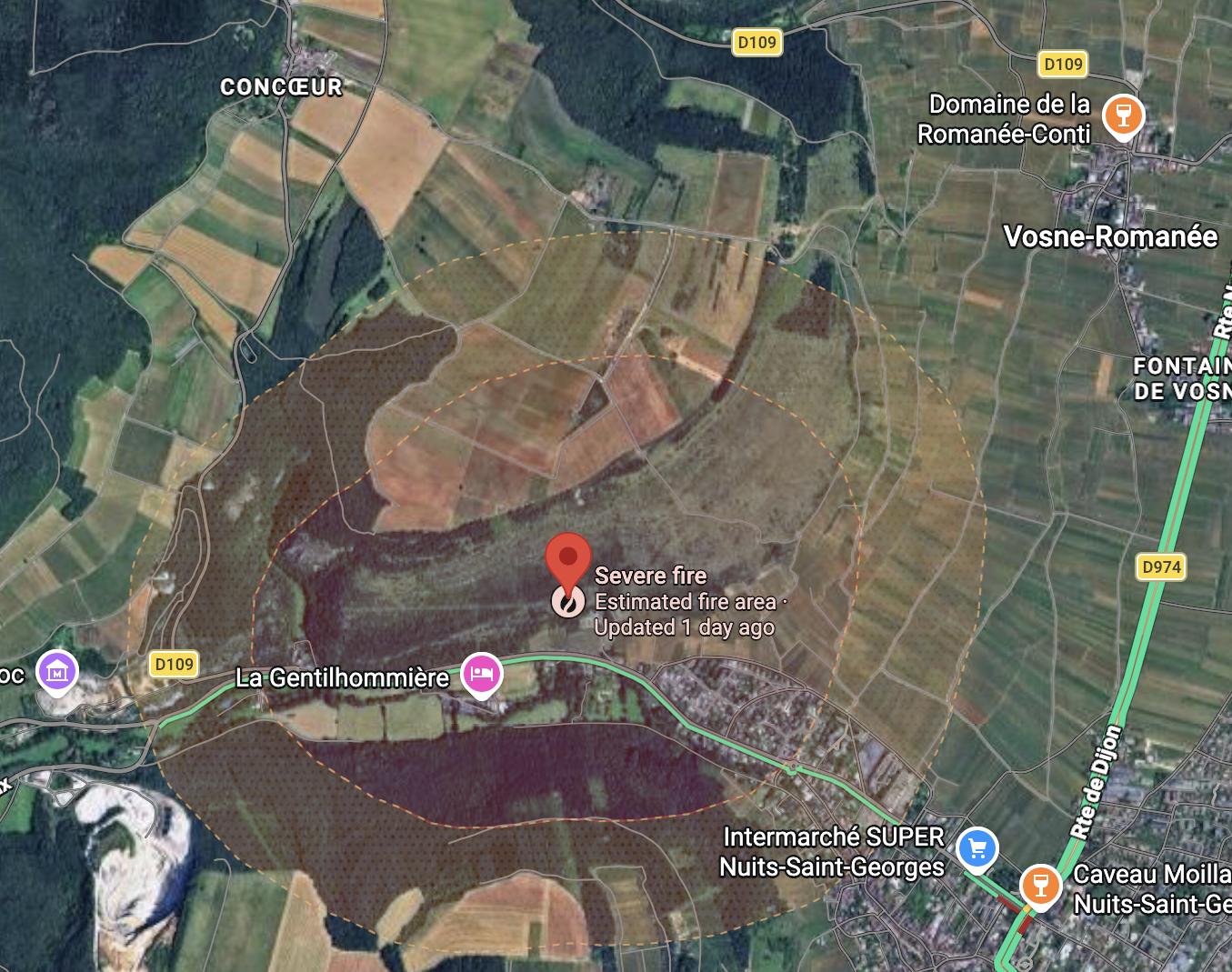
The largest fire ignited in the early afternoon on the heights of Nuits-Saint-Georges, along the Route de la Serrée, above the local tennis courts. By the time the first crews arrived, an immense column of smoke was already visible from kilometers away, fed by tinder-dry undergrowth and a persistent west wind.
Over the course of the afternoon, the fire consumed 40 hectares of woodland and scrub. The response was immediate and massive: nearly 120 firefighters, dozens of engines, and — in a move described as exceptionally rare by the SDIS 21 — reinforcements from six neighboring departments: Saône-et-Loire, Jura, Doubs, Haute-Saône, Meurthe-et-Moselle, and the Vosges.
By Thursday morning, the Nuits-Saint-Georges fire was mastered, though crews remained on site dousing residual hot spots and monitoring for re-ignition. Four forest-fire tankers stayed engaged through the day.
Further south, near the Saône-et-Loire border, the commune of Monthélie — itself home to respected Premier Cru vineyards — saw 5 hectares scorched. As of Thursday, numerous hot spots persisted within the burned zone, requiring what firefighters termed “a meticulous treatment.”
Smaller fires also flared at Villecomte (north of Dijon, ~4 hectares) and Jours-lès-Baigneux (~1 hectare), keeping more than 200 Côte-d’Or firefighters on rotation through the night.
Map: Fire Locations Across the Department

Romanée-Conti at Risk: The Smoke Drifted East
Perhaps the most alarming detail for the fine-wine world is the fire's position relative to Vosne-Romanée, home to the legendary Romanée-Conti vineyard. The Nuits-Saint-Georges blaze burned on the western heights above the Route de la Serrée, and the prevailing west wind carried the dense smoke plume directly eastward — over the ridge line that separates Nuits-Saint-Georges from Vosne-Romanée.
At its peak, the smoke column was visible from Dijon, more than 20 kilometers away. For the parcels of Romanée-Conti, La Tâche, Richebourg, and the other Grand Crus of Vosne-Romanée, the fire was not a distant headline. It was an atmospheric event depositing volatile phenolic compounds onto fruit that is already entering the critical pre-veraison phase. While the Domaine de la Romanée-Conti has not issued a public statement, local growers in the commune report that the smell of smoke lingered in the vineyards for hours after the flames were brought under control.
The Forecast: No Relief in Sight
The fires did not arrive in a vacuum. They were the product of a brutal confluence: weeks of drought, vegetation parched to its ignition point, and a heatwave that pushed Dijon to 36°C on Monday, July 7. Météo France maintained an orange heatwave and forest-fire alert for Côte-d’Or through Thursday, July 9.

Critically, the forecast offers little in the way of meaningful rainfall. A few scattered showers may appear around July 12–13, but totals are expected to remain minimal. For firefighters, that means the threat of re-ignition at Nuits-Saint-Georges and Monthélie will persist until significant precipitation arrives — something that is not currently in the cards.
Impact on the Vine: Grapes Tainted with Smoke
Burgundy has largely been spared the catastrophic vineyard losses seen further south in the Pyrénées-Orientales, where approximately 4,900 hectares have burned and some wineries have lost 90% of their planted area. In Burgundy, the damage has been more limited — but the impact on fruit quality is already becoming apparent.
Immediate Concerns
- Smoke-Tainted Grapes: Even though vines themselves resist ignition, smoke from the Nuits-Saint-Georges and Monthélie fires has deposited guaiacol and 4-methylguaiacol compounds onto grape skins across exposed parcels. Growers in Nuits-Saint-Georges, Vosne-Romanée, and the Hautes-Côtes de Nuits report that early berry sampling is already showing elevated smoke markers in fruit from windward-facing rows. In this sensitive pre-veraison window, the risk is acute: the grapes have not yet developed the thick cuticle and concentrated sugars that can partially mask smoke uptake. Winemakers are now facing the unenviable decision of whether to harvest smoke-affected blocks separately, apply activated carbon or reverse-osmosis treatments, or — in the worst cases — discard fruit from the most exposed parcels. For a region where a single hectare of Grand Cru can represent millions of euros in bottle value, the economic stakes are immense.
- Heat Stress: With temperatures consistently above 30°C, vines are under significant water stress. In a region where irrigation is heavily restricted and dry-farming is the norm, extended heat can shut down photosynthesis, arrest sugar accumulation, and — in extreme cases — cause leaf scorch and berry desiccation.
- Infrastructure: Firefighting operations can damage vineyard access roads, irrigation lines (where permitted), and estate boundaries. The heavy presence of fire crews and vehicles on narrow vineyard lanes also complicates the normal summer work of canopy management and disease monitoring.
Longer-Term Questions
The Dijon prosecutor has opened multiple judicial investigations into the origins of the various fires. No arrests have been made, and officials have stated that the fires do not appear to be linked. In a region where every hectare of Grand Cru carries astronomical value, the possibility of arson — or even negligent ignition — is being taken extremely seriously.
More broadly, the events of July 8 fit into a worrying pattern. French wine regions from the Loire to the Mediterranean are increasingly confronting fire as a seasonal risk. In the Loire, a fireworks-triggered blaze near Saint-Michel-sur-Rhône destroyed nearly half a hectare of Marsanne vines earlier in the week. The combination of extreme heat, drought, and ignition sources is no longer a theoretical climate risk; it is an operational reality.
Looking Ahead
For the Côte de Nuits, the immediate priority is ensuring the Nuits-Saint-Georges and Monthélie fires are fully extinguished and that no embers survive to reignite when the wind shifts. Fire crews are expected to maintain a presence through the weekend.
For winemakers, the focus turns to the vines and the cellar. The 2026 growing season was already shaping up to be an early, warm vintage. If the heat persists without rain, the region may face one of its most hydrically stressed harvests in recent memory — compounded now by the specter of smoke-tainted lots from some of its most celebrated terroirs. Conversely, if the rumored showers of mid-July materialize, they could reset the vine cycle, wash some smoke residues from the fruit, and avert the worst outcomes.