Sunday Round Up Wk 20
Sunday Wine News Roundup
A market in retreat, a valley under water, and the structural forces reshaping the world of wine this week.
U.S. Market Hits Record $115 Billion Amid "Structural Reset"
Americans spent more on wine in 2025 than ever before — pushing total U.S. consumer spending past $115 billion — yet they also drank less of it. The newly released 2026 BMO Wine Market Report reveals a growing disconnect between price and demand that is forcing wineries to fundamentally rethink how, where, and what they sell.
- Market value rose 3% in 2025, even as total volume declined for another consecutive year
- Direct-to-consumer shipments fell 15% in volume to 5.4 million cases
- California wine entering the U.S. market has dropped nearly 25% in less than a decade
- 71% of wineries expect the industry to stabilize or rebound within three years
- Flavored wines grew 12% while sparkling wine volumes declined 3%
— Adam Beak, Head of Wine & Spirits at BMO
Newer Wine Regions Hit Hardest by Declining Demand
The pain is not evenly distributed. As global wine consumption continues its decade-long slide, it's the up-and-coming appellations — not the established icons — bearing the brunt of the collapse.
Twenty-five years ago, you couldn't go wrong planting wine grapes in California. Demand was booming, outstripping supply from Napa and Sonoma, and enterprising growers fanned out across the state — to the Dunnigan Hills, the Kelsey Bench, Fiddletown, Edna Valley, and Lodi — petitioning the federal government to recognise new American Viticultural Areas (AVAs).
That playbook is now in tatters. "The problems are focused more on the value end rather than the premium side of the market, but the entire industry is affected," says Erik McLaughlin, CEO of Metis Mergers & Acquisitions.
The mechanics are brutal: a 5% drop in a winery's sales can translate to a 20–40% reduction in grape intake. Winemakers can sit on inventory. Growers must sell a crop every year — or watch it rot.
Vineyards in Lake, Amador, Yolo, and Monterey counties are being torn out or left to wither. Some growers are "mothballing" vines — slashing irrigation, skipping fertiliser, pruning minimally — in the faint hope prices recover.
Jeff Bitter, President of Allied Grape Growers, traces the problem back to the AVA boom itself. "In the Eighties and Nineties, the proliferation of AVAs was largely driven by wineries and growers wanting to differentiate and promote themselves. But sometimes there can be too much differentiation. It can be confusing and intimidating." In an era of declining interest, consumers retreat to the familiar: Napa, Sonoma, and little else.
— Erik McLaughlin, Metis Mergers & Acquisitions
Global Wine Trade Hits Lowest Volume Since 2009
U.S. tariffs contributed to a further decline in global wine trade last year, with world wine exports falling 4.7% in volume to 94.8 million hectolitres — the lowest since 2009. Export value dropped 6.7% to €33.8 billion.
Wine consumption globally slipped 2.7% to 208 million hectolitres, the lowest since 1957, according to the OIV.
Non-Alcoholic Wine Booms as Traditional Sales Soften
U.S. wine volume fell to roughly 329 million cases in 2025 (down from 335.9 million in 2024), while the non-alcohol category surged. NielsenIQ reported U.S. off-premise sales of non-alcoholic beer, wine and spirits reached $925M (up 22% year-over-year).
Crucially, 92% of non-alcohol buyers also purchase alcoholic products, indicating consumers are building broader drinking repertoires rather than quitting entirely.
France to Uproot 28,000 Hectares of Vines
In a major structural move, France plans to uproot 28,000 hectares of vines due to falling demand and climate strain. This represents one of the largest vineyard reduction programs in recent French history.
Meanwhile, Uruguay has declared wine a "living culture" in a landmark policy move, and South African wine is gaining traction in China as tariffs drop to zero.
EU-U.S. Wine Trade Under Pressure
European wine faces a 15% U.S. tariff, and the 2025 trade compromise is at risk of collapse due to ongoing political tensions. U.S. imports of European wine dropped 11% in January 2026 to €1 billion.
The OIV notes the sector is adapting by focusing more on wine tourism, sustainability, and lower-alcohol products.
Too Many Wineries, Not Enough Consumers
Banks are telling U.S. wineries that some need to get out of the pool. Nearly a quarter of wineries surveyed lost a primary distributor in the past year. DTC shipments have shrunk back to 2020 levels in dollars and 2016 levels in volume.
More than 30% of wineries are looking to sell off estate product as bulk, and 11% are holding bottled, unlabeled wine.
South Africa's Western Cape Devastated by Severe Flooding
Vineyards along the Breede River have been submerged after the river burst its banks, with the Robertson Wine Valley suffering its fourth major flood in three years.
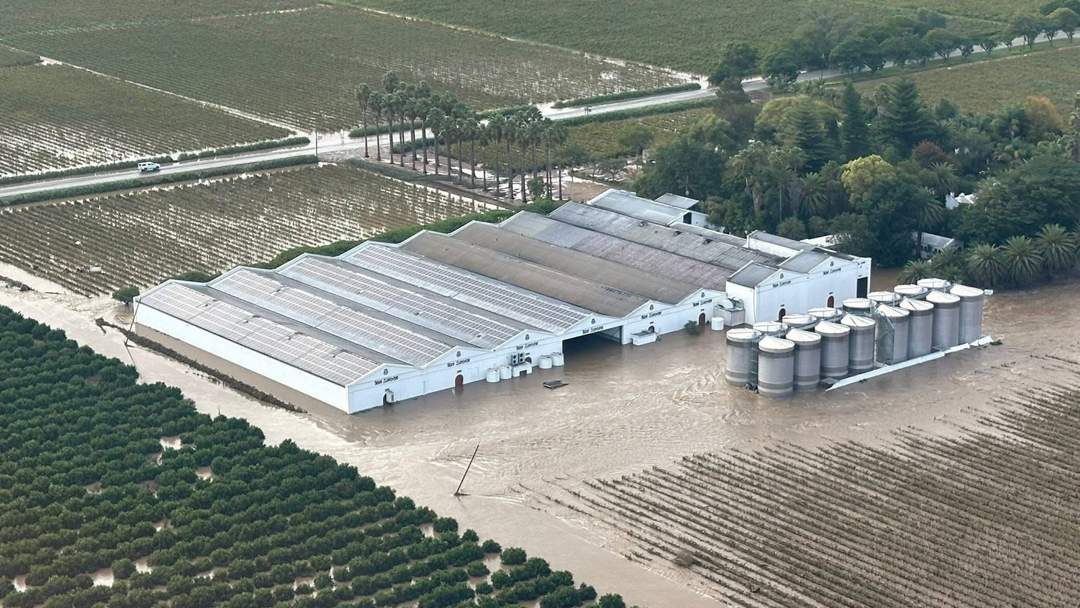
Aerial view of Van Loveren Family Vineyards surrounded by Breede River floodwaters. The winery saw water reach nearly two metres throughout its cellars. — News24
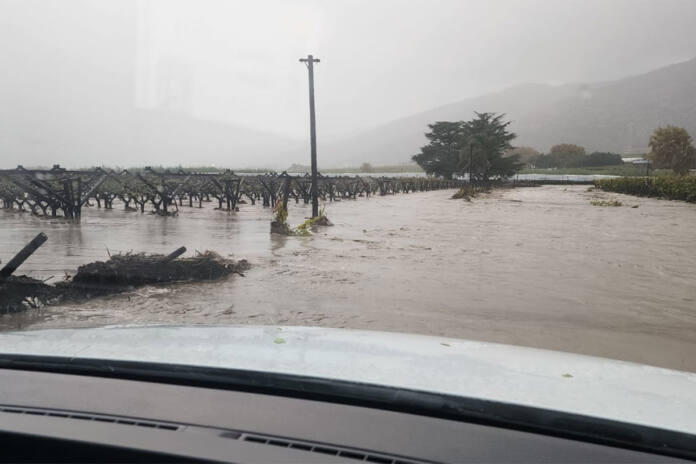
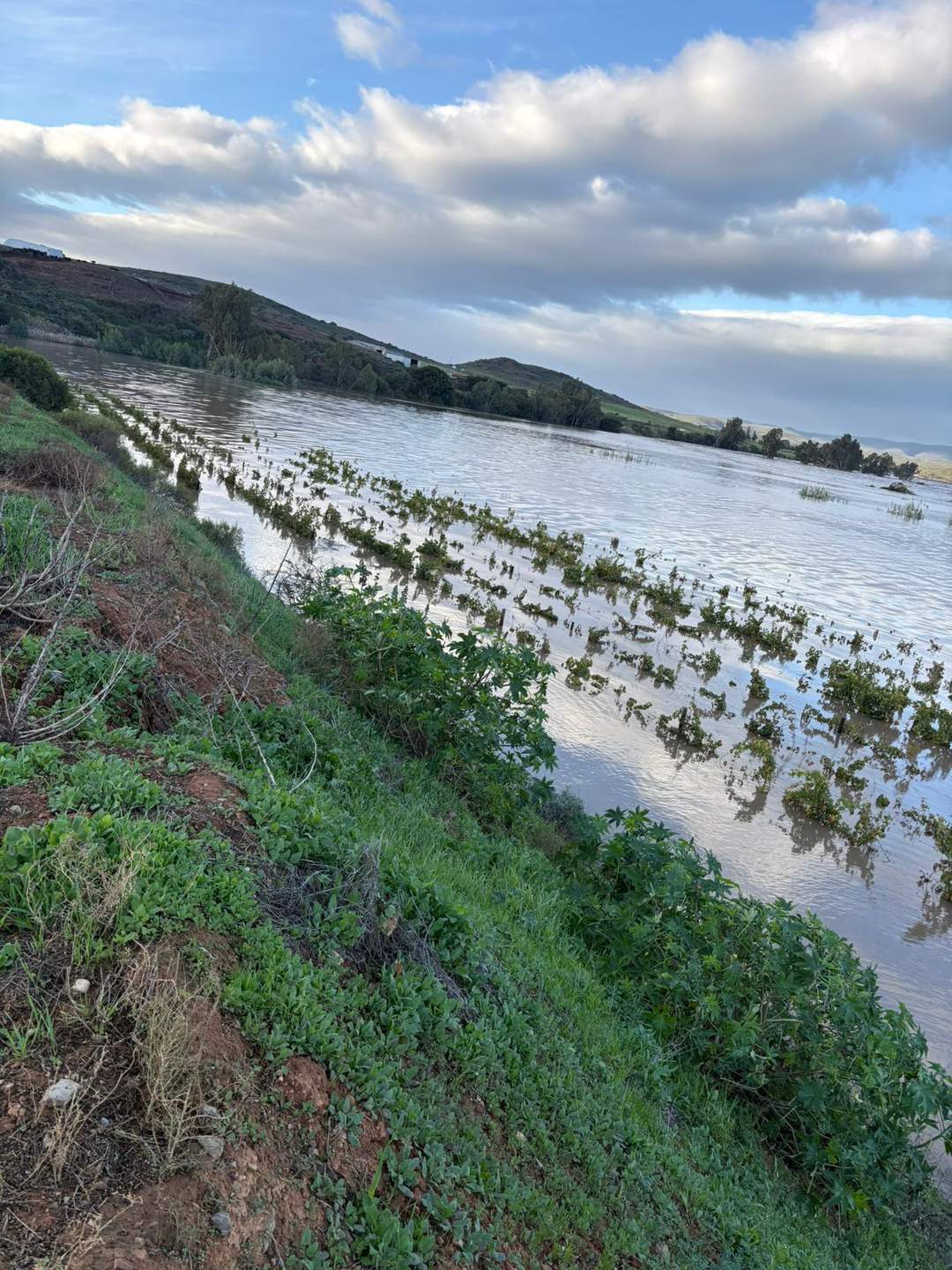
Left: Flooded vineyards near Worcester. Right: Submerged vines in the Robertson Valley after the Breede River burst its banks. — Farmers Weekly / News24
On the weekend of May 11–12, heavy storms hammered South Africa's Western Cape. While Robertson itself received just 20mm of rain, upstream catchment areas were deluged with 200–300mm. By Monday evening, the Breede River had burst its banks, sending a wall of water cascading through the Robertson Wine Valley.
The damage is catastrophic and familiar. Springfield Estate, one of the valley's most respected producers, reported that 90 of its 220 hectares were submerged. "15 hectares of new vineyards planted last winter have been completely washed away — soil preparation, cover crops, irrigation, trellising and vines, gone in a matter of hours," the estate posted online. "Our rebuilt pumphouse, all eight frost-fan motors, and our private transformer have all been hit."
- 90 hectares submerged at Springfield Estate (of 220ha total)
- 15 hectares of newly planted vineyards completely washed away
- 1.3 million bottles of wine lost at Van Loveren Family Vineyards
- ~2 metres of floodwater throughout the Van Loveren winery
- 20 homes on and around the Van Loveren property affected
- 4th major flood in the Robertson Valley in just 3 years
Van Loveren Family Vineyards, another cornerstone of the valley, saw floodwaters reach nearly two metres throughout its winery. Initial assessments indicate the loss of 1.3 million bottles of wine, barrels, filtration systems, and solar battery infrastructure. Approximately 20 homes on and around the property — including employee, owner, and rental residences — were affected.
— Van Loveren Family Vineyards
The cruellest twist? Springfield Estate had done everything possible to prepare. Since 2023, they had deepened and widened the river channel, raised retaining walls and dykes by three metres, lifted walls around frost fans by two and a half metres, and rebuilt their pumphouse on a new site "higher and stronger than we ever believed necessary." All of it proved futile against the scale of this flood.
The human toll extends far beyond wine. The Western Cape government confirmed 10 fatalities across the province, with nearly 90,000 people displaced. In the Cape Winelands alone, over 2,200 people were forced from their homes. The Clanwilliam Dam is at 103% capacity with all sluices open, and the Breede River was flowing at 1,655 cubic metres per second at Swellendam — a volume that renders downstream flooding a near-certainty.
Yet amid the devastation, the valley's response has been swift and communal. Van Loveren has confirmed that wine stock in tanks remains unaffected, alternative warehouse facilities are operational, and urgent bottling and recovery plans are already underway. Managing Director Phillip Retief struck a defiant but realistic tone:
Wineries across the affected area are encouraging the public to buy their wines to help fund rebuilding — a poignant reminder that for wine regions on the edge, survival depends not just on weather, but on the loyalty of drinkers thousands of miles away.
The Bottom Line
The overarching theme this week is an industry being squeezed from both ends. Demand is structurally weakening as younger generations drink less and retreat to familiar brands. And climate is becoming less predictable, hitting regions that can least afford the loss.
The newer appellations of California and the flood-battered valleys of the Western Cape are not the wine world's wealthiest players. They are precisely the regions that need growth, investment, and stable conditions to build their futures. Instead, they face a market that no longer wants their grapes and a climate that no longer respects their defences.
For the consumer, the message is clear: the wines that survive this era of contraction and chaos will be the ones worth seeking out — not because they are famous, but because they are still standing.