North Americas Top 50 and Which are Natural?
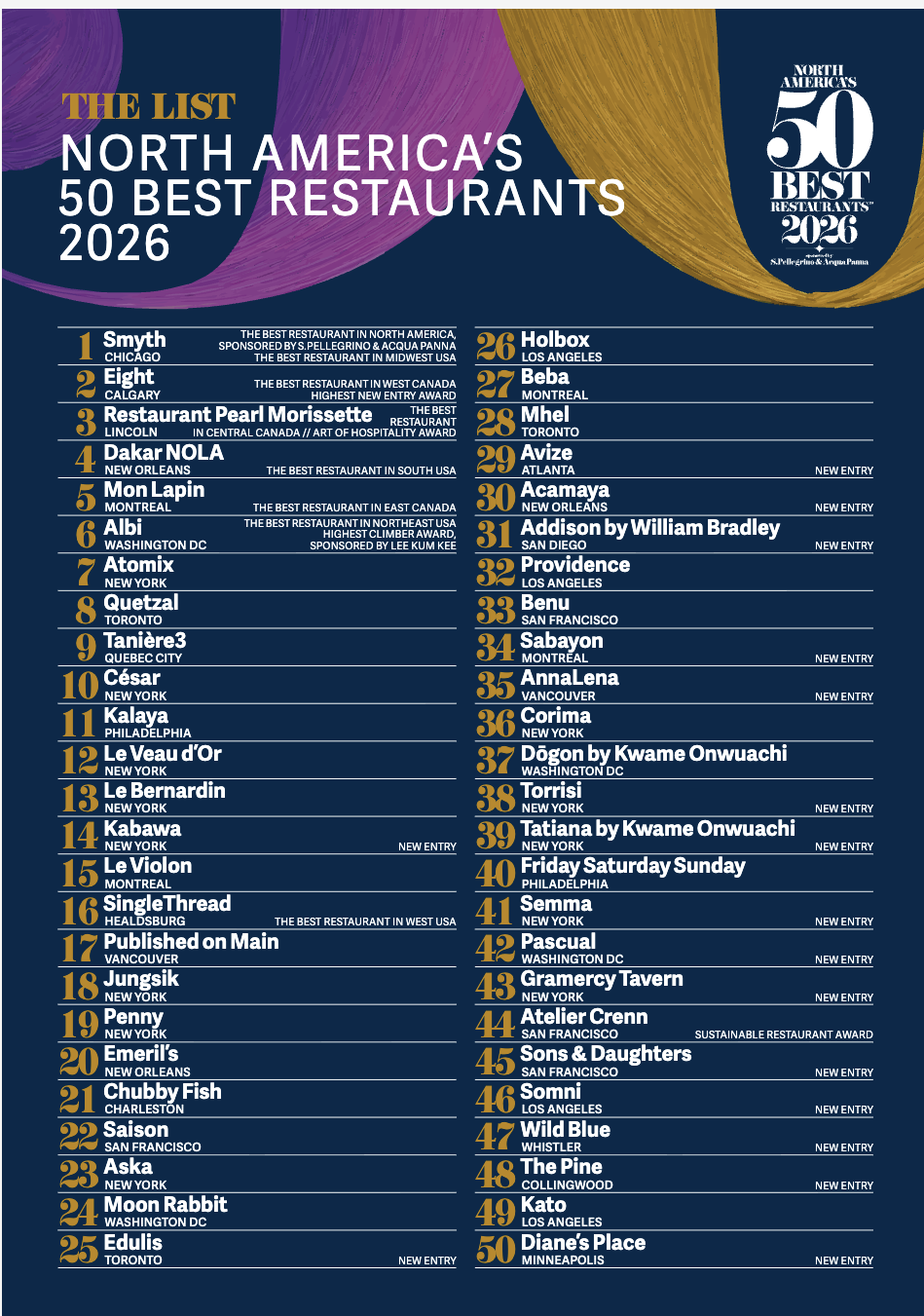
North America's 50 Best Restaurants 2026
A Wine Lover's Guide to the List
The 2026 edition of North America's 50 Best Restaurants has landed, and for those of us who measure a great meal as much by what's in the glass as what's on the plate, this year's list offers plenty to get excited about. From Montreal's natural wine temples to San Francisco's Burgundy vaults, we've mapped the wine credentials of every establishment — with particular attention to the restaurants flying the flag for natural, low-intervention and small-producer wines.
The undisputed natural wine capital of the 50 Best list. Opened in 2018 in Little Italy by husband-and-wife duo Marc-Olivier Frappier (chef) and Vanya Filipovic (sommelier), Mon Lapin is the spiritual home of Canada's natural wine movement. The name itself pays tribute to Jura legend Jean-François Ganevat, famous for calling all his friends "mon lapin" ("my rabbit").
Filipovic — named North America's Best Sommelier 2025 — has built a cellar composed entirely of bottles from small producers, with a heavy tilt toward natural wines. The concise menu lists around 15 shareable plates built from Quebec's finest: house-matured meats, ultra-fresh fish, house-made pasta, and seasonal vegetables. The Croque-Pétoncle, a riff on the Lyonnais quenelle pressed into a toasted sandwich, has become a signature.
"The wine cellar is made up of bottles from small producers, with a lot of natural wines." — Michelin Guide
The Full List: Where to Drink & What to Order
Two Michelin stars and one of Chicago's most estimable wine lists. Under wine director Kevin Goldsmith, the program has become a powerhouse of back-vintage Burgundy, aged German Riesling, and generous pairings. The "Super Mega" pairing is the one to book.
An 18-seat kitchen-theatre from chef Darren MacLean. The 15-course Canadian Reflection Menu comes with wine pairings, and the restaurant also hosts Cultural Chef Exchange events with visiting international wine programs.
A 42-acre destination in Niagara where the restaurant sits atop the winery. Chefs Daniel Hadida and Eric Robertson champion Canadian ingredients and a regenerative garden. Their own wines — including the skin-fermented amber wine Irrévérence — are low-intervention, and the list features like-minded producers. Michelin Green Star and one Michelin Star.
Modern Senegalese tasting menu from chef Serigne Mbaye. Sommelier Imani Pittman curates a pairing program that reaches from Rías Baixas Albariño to South African Chenin Blanc and Japanese plum sake. A $100 wine pairing accompanies the $150 tasting menu.
Levantine cuisine from chef Michael Rafidi, with a wine list curated by William Simons — winner of the Michelin Guide Washington DC 2024 Sommelier Award. The ~300-bottle list is built around tone and emotion rather than grape or region, with categories like "Donnie Darko Reds." Natural wine sits comfortably alongside Lebanese legends like Chateau Musar.
Chef Junghyun Park's 12-seat Korean fine-dining counter. The wine list — curated by Beverage Director Jhonel Faelnar — skews heavily toward white wine and Champagne to match the vegetable and fish-forward menu. Pairings run $250–$550, with a non-alcoholic option at $125. The 400–500 bottle selection is constantly shifting.
Mexican cuisine from chef Kate Chomyshyn and Julio Guajardo. The beverage program focuses on Mexican spirits, but the wine list complements the wood-fired cooking with a thoughtful selection of Old and New World bottles.
An intimate 20-seat tasting menu restaurant in Old Quebec. The wine program focuses on pairings that match the seasonal, terroir-driven cuisine.
Chef Daniel Boulud's intimate uptown restaurant. The wine program is classic French-focused, with strong Burgundy and Bordeaux selections.
Chef Chutatip "Nok" Suntaranon's Thai restaurant. The wine list is designed to handle spice and heat, with aromatic whites and off-dry options leading the charge.
A revived classic French bistro with a wine list to match the old-school menu. Expect traditional Burgundy, Bordeaux, and Loire selections.
Eric Ripert's seafood temple. The wine program — overseen by Aldo Sohm at his eponymous wine bar nearby — is one of New York's most celebrated, with deep Burgundy, German Riesling, and Austrian selections.
New entry to the list. A Japanese-inspired restaurant with a wine and sake program designed to complement the precise, seasonal cuisine.
Chef Danny Smiles' intimate Plateau restaurant. Wine director Esme Millar has built a list that "balances natural and classic selections" around smaller producers who share the restaurant's local ethos. Bottles start around $70.
Kyle and Katina Connaughton's farm-to-table masterpiece. The wine program integrates estate-grown wines with a focus on regenerative agriculture. The list champions Sonoma County and beyond, with a sustainable, closed-loop philosophy.
Chef Gus Stieffenhofer-Brandson's West Coast restaurant with German influence. The wine list — curated by Haley MacLeod — "favours the small scale, especially natural and low-intervention wines, with many poured by the glass." A Star Wine List finalist for "Best International Sustainable Wine List" and one of only two Champagne Krug Ambassades in Canada.
Chef Jungsik Yim's modern Korean fine dining. The wine list is designed to complement the bold, precise flavors of the tasting menu.
A neighborhood gem with a focused, eclectic wine list. The program leans toward interesting, food-friendly bottles from emerging regions.
Emeril Lagasse's flagship. The wine program is deep and classic, with strong representation from Bordeaux, Burgundy, and California.
Seafood-focused restaurant with a strong commitment to domestic wines. The list includes natural producers like Monte Rio Cellars, poured alongside local and sustainable selections.
One of the country's largest and most remarkable wine selections, with a special emphasis on Burgundy. Founded by Mark Bright, the list is now curated by Beverage Director Molly Greene. The "Wines from the Hearth" club offers global bottles handpicked by the team. Deep verticals of DRC, Rousseau, and rare back-vintage Champagne.
Chef Fredrik Berselius's two-Michelin-star Nordic restaurant in Brooklyn. The wine list includes natural and low-intervention producers, with a focus on wines that match the foraged, hyper-seasonal cuisine.
Chef Kevin Tien's Vietnamese-American restaurant. The wine list offers "surprising range of geography and grape type" with suggested pairings for each dessert.
New entry. A seafood-focused restaurant with a wine list built around Old World classics and natural wine discoveries.
Gilberto Cetina's Mexican seafood counter in Mercado La Paloma. The beverage program focuses on Mexican beers and spirits, with a small selection of wine.
Chef Pablo Rene's Argentine-inspired restaurant in Verdun. The wine list naturally leans toward South American producers, with a strong Malbec and Torrontés selection.
Chef Brigitte Shim's tasting menu restaurant. The wine program is designed as a pairing experience to match the architectural, multi-course menu.
Alpine-inspired cuisine from chef David Bies. The wine list is organized by style — "electric/fresh," "robust/opulent," "vibrant/dazzling" — with German Pinot Noirs, Austrian Grüner Veltliner, and plenty of Champagne. Beverage director Taurean Philpott champions sparkling as the most versatile style.
New entry. A Mexican seafood restaurant with a beverage program focused on agave spirits and Mexican wines.
San Diego's only Michelin three-star restaurant. The wine program holds a Wine Spectator Grand Award, with strengths in Burgundy, California, Rhône, Bordeaux, Italy, Champagne, and Germany. Sommelier Kyle South oversees a cellar of extraordinary depth.
Chef Michael Cimarusti's seafood institution. The wine list is deep in white Burgundy, Champagne, and wines that complement seafood.
Chef Corey Lee's three-Michelin-star restaurant. The wine program is precise and curated, with a strong Asian-influenced selection alongside classic French.
New entry. A contemporary Montreal restaurant with a wine list focused on Quebec and French producers.
New entry. Chef Michael Robbins' restaurant with a wine list that explores Pacific Northwest and international producers.
Chef Fabián von Hauske's Mexican restaurant. The beverage program champions Mexican spirits and a curated wine selection.
Kwame Onwuachi's Afro-Caribbean restaurant. The wine list is designed to match the bold, spice-forward cuisine.
New entry. The Major Food Group's Italian-American restaurant with a wine list focused on Italian producers.
New entry. Located in Lincoln Center, with a wine program that reflects the restaurant's Afro-Caribbean and American influences.
A tasting menu restaurant with a wine list that rotates to match the ever-changing menu. Natural wine makes regular appearances.
New entry. Chef Vijay Kumar's South Indian restaurant. The wine list is designed to handle intense spice and complex flavors.
New entry. A Mexican restaurant with a beverage program focused on mezcal, tequila, and Mexican wines.
New entry. Danny Meyer's enduring classic with a wine list that balances American and European producers, with a strong by-the-glass program.
Chef Dominique Crenn's poetic, vegetable-forward restaurant. The wine list is curated to match the artistic, sustainable ethos of the cuisine.
New entry. A tasting menu restaurant with a wine list focused on small producers and sustainable viticulture.
New entry. Inside the SLS Hotel, with a wine program designed for the avant-garde tasting menu.
New entry. A mountain restaurant with a wine list that explores Pacific Northwest and international selections.
New entry. A Canadian restaurant with a wine list focused on Ontario and international producers.
Chef Jon Yao's Taiwanese-American restaurant. The wine list is curated to match the delicate, precise flavors of the cuisine.
New entry. A neighborhood restaurant with a wine list that champions small producers and natural wine.
The Natural Wine Shortlist
For the purist, these are the establishments on the 2026 list where natural, low-intervention, and small-producer wines are not just available — they're the philosophy:
- #3 Restaurant Pearl Morissette — Low-intervention winemakers + their own estate wines
- #5 Mon Lapin — The list is natural and mature. Full stop.
- #6 Albi — Natural wine explored through a Levantine lens
- #15 Le Violon — Natural and classic selections from smaller producers
- #17 Published on Main — "Natural and low-intervention wines, many poured by the glass"
- #21 Chubby Fish — Domestic natural wines including Monte Rio Cellars
- #23 Aska — Natural wine in a Nordic, two-Michelin-star setting
- #40 Friday Saturday Sunday — Rotating natural wine appearances
- #50 Diane's Place — Small producers and natural wine championed
Why Mon Lapin Matters
In a list dominated by tasting-menu temples and white-tablecloth institutions, Mon Lapin stands out as the place you'd actually want to spend three hours on a Tuesday night. It is casual, loud, and unapologetically fun — the kind of restaurant where the sommelier might open a magnum of Jura Savagnin because she feels like it, and where the fried oysters taste better because the wine beside them is alive.
Vanya Filipovic doesn't just curate a natural wine list; she imports the wines herself through Les Vins Dame-Jeanne, her own import business. That direct pipeline means bottles at Mon Lapin that you won't find elsewhere in Canada — and often at prices that defy the current markup economy. The restaurant's ascent to #5 on this list (and #2 in North America in 2025) is proof that the wine world's center of gravity is shifting. The old hierarchies are cracking. The future belongs to the rabbits.
"Visionary wines, a list filled with vibrant and eclectic bottles." — TripAdvisor
Methodology & Notes
The North America's 50 Best Restaurants 2026 list was announced on May 28, 2026, in Mexico City. The list spans the United States, Canada, Mexico, and the Caribbean, with restaurants ranked by an academy of 300+ voters including chefs, restaurateurs, food writers, and well-travelled gourmets. Wine list information was compiled from official restaurant websites, Michelin Guide entries, Star Wine List, Wine Spectator, and verified diner reviews. Natural wine designations are based on explicit statements from the restaurants or their sommeliers regarding low-intervention, organic, biodynamic, or natural winemaking philosophies.