The Vineyards in the Sky: How Florence's Airport is Growing Wine on its Roof
Rafael Viñoly Architects
The Vineyards in the Sky
How Florence's Amerigo Vespucci Airport is growing 38 rows of wine grapes on its roof—creating the world's first terminal that produces its own wine.
Tuscany's newest vineyard isn't nestled in the rolling hills of Chianti or perched on a hillside outside San Gimignano. It's being built on top of an airport terminal.
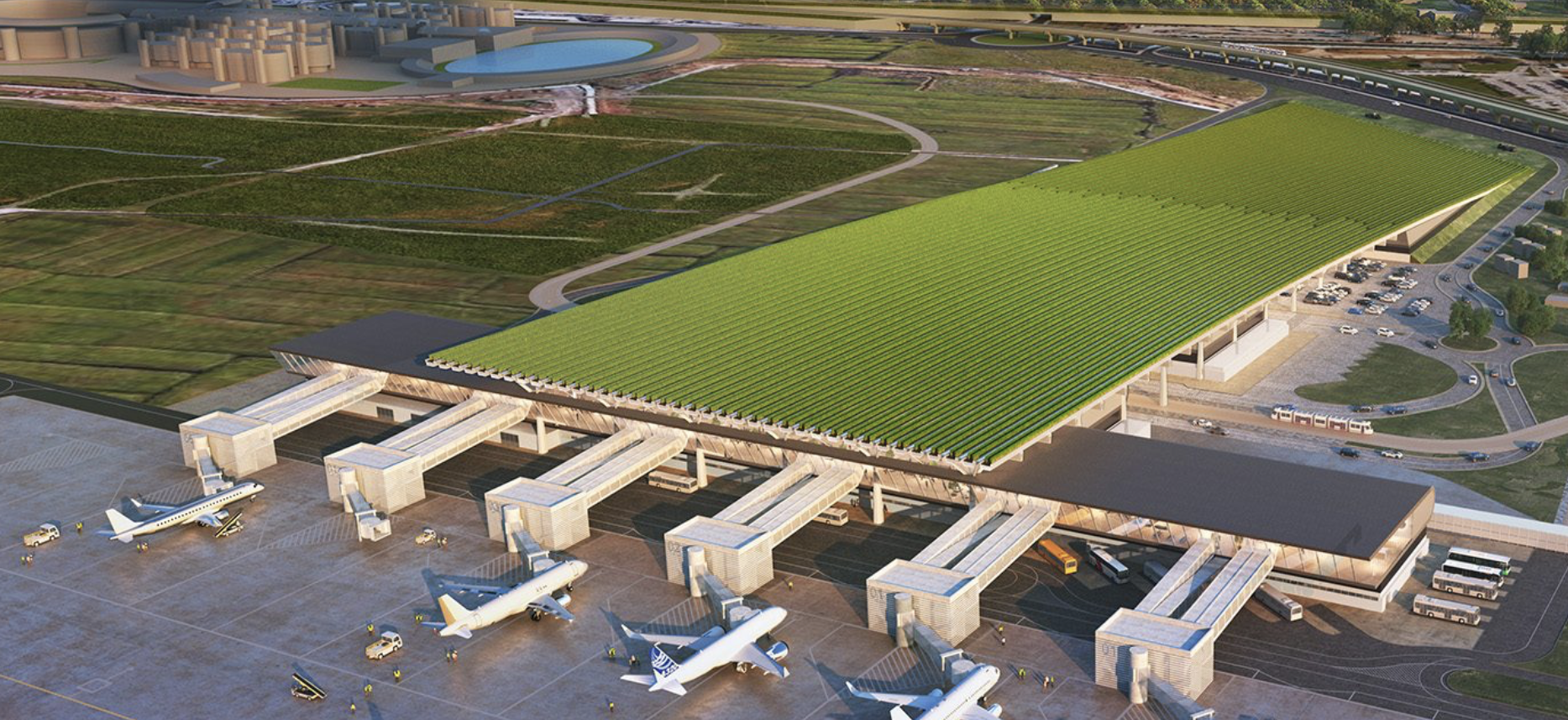
When the new Amerigo Vespucci Airport terminal opens in 2026, travelers won't just be passing through Florence—they'll be walking beneath a working vineyard, with 38 rows of vines producing wine literally overhead.
The Architecture of Wine
The numbers tell a story of agricultural ambition: 7.7 hectares (19 acres) of vineyard covering the terminal roof, divided into 38 distinct rows measuring approximately 2.8 meters wide and stretching between 1,500 and 1,870 feet in length. These aren't decorative plantings. This is a functional, productive vineyard designed to yield actual wine.
But not all rows are created equal. In a sophisticated engineering solution to safety concerns, only 2.4 hectares (6 acres) at the eastern end of the roof—furthest from the runways—will bear fruit. These productive vines sit on a berm at the origin point of the roof, away from jet fumes and foreign object debris risks.
The remaining two-thirds of the vineyard consists of non-fruit-bearing vines that maintain the visual continuity of an endless vineyard while eliminating safety hazards near the apron.
He saw an opportunity to be a 21st-century Medici, to undertake something truly grand and provide the city with an appropriate gateway.
Román Viñoly on Eduardo Eurnekian
Root to Bottle
This isn't just about growing grapes—it's about making wine. A leading regional vintner will be appointed to cultivate the vines, with the resulting harvest vinified and aged in cellars located directly beneath the terminal roof, tucked behind the departure hall.
Passengers won't merely glimpse the vineyard through skylights; they'll be able to visit the winery itself. The cellars will be open for tours, allowing travelers to witness wine production and aging within the airport premises—a tasting room experience that begins the moment they clear security.
The Terroir
The vision behind this viticultural airport comes from Eduardo Eurnekian, the Armenian-Argentine president of Corporación América. Eurnekian knows wine: he already owns two wineries—Bodega del Fin del Mundo in Patagonia and Karas in Armenia.
The architectural team, led by the late Rafael Viñoly, embraced the challenge of creating productive rather than merely decorative green space. "Initially, we were concerned about whether this would result in too little wine," Viñoly admitted. "But once we learned about the productive capacity of this section, I was amazed."
Climate & Culture
The vineyard serves practical environmental purposes beyond wine production. The green roof provides evaporative cooling and thermal insulation, negating heat gain through opaque roof surfaces and contributing to the terminal's targeted LEED Platinum rating.
When viewed from Florence's historic center, particularly from Brunelleschi's Duomo 6.5 miles away, the terminal disappears entirely behind what appears to be an extension of the Tuscan countryside. The "lifted" vineyard creates an ascending landscape that shelters the building while maintaining visual continuity with the region's agricultural heritage.
When Phase One completes in 2026, Amerigo Vespucci won't just be an airport with a green roof. It will be a winery that happens to process passengers—a vineyard where the harvest is interrupted by arriving flights, and the first place in the world where you can watch your plane taxi to the gate while standing among the grapes that will eventually fill your glass.