Light Does the Hoeing
Viticulture · Technology · Labor
Weeding by Light
A machine that kills weeds with lasers — no herbicide, no soil disturbance, no hand crew — has just left China for Australian vineyards. What the Laser Weeder H8 means for the row middle, the under-vine strip, and the quiet labor arithmetic every estate runs each spring.
In early July 2026, a tractor-towed machine rolled out of Harbin and onto a ship bound for Australia, and the wine trade barely noticed. It should have. The Laser Weeder H8 — built by Harbin Huagong Zhiyun Technology, an agricultural arm of Wuhan-based HGTECH — carries twelve vision systems and eight laser units, and it does the one job vineyards have never found a clean answer for: killing the weeds in the under-vine strip without chemicals, without cultivation, and without a crew of twenty on their knees.
The record
The headline numbers are company figures, but they are striking. The H8's cameras distinguish crop from weed at the 0.1-millimetre level — fine enough to tell a vine shoot from a grass blade — and the system claims to treat up to 288,000 weeds per hour, removing around 95 percent of them in a single pass. Early field trials in Heilongjiang and Yunnan ran at 90–92 percent before the recognition models were refined; the export unit to Australia is the improved machine. The entire sequence, from image capture to laser strike, completes in under 100 milliseconds. On the company's larger autonomous unit, under five.
The Laser Weeder H8 — the numbers
The machine
The physics is surgical rather than spectacular. The vision stack identifies a weed, the laser paints its meristem — the growth tissue where new cells divide — and the cells' water flash-vaporizes, rupturing the tissue. The weed does not burn; it simply loses the ability to regrow. For viticulture this distinction matters twice over. There is no herbicide residue to manage, which clears organic and biodynamic certification headaches at a stroke. And there is no cultivation, which means the fungal networks and soil structure under the vine — the quiet infrastructure of terroir — are left entirely intact. A hoe, for all its virtue, is a blunt instrument. A laser is not.
The weed does not burn; it simply loses the ability to regrow.Company technical materials, HGTECH
The field it enters
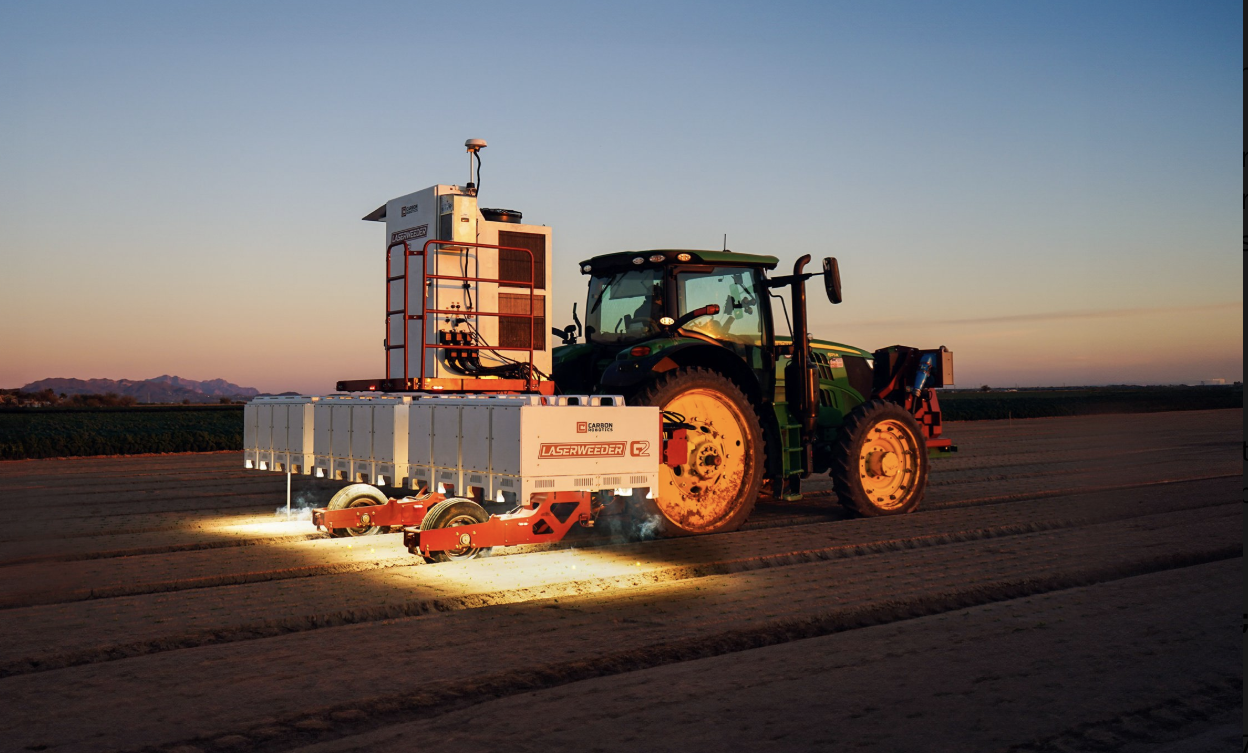
The H8 is not arriving in an empty market. Seattle's Carbon Robotics has sold its LaserWeeder — thirty lasers, forty-two cameras — commercially since 2022, and it now operates across some fifteen countries, including Australia. Between them, the two machines define the category: towed units for conventional estates, autonomous platforms for the largest. What has changed is the price floor. American machines list at $1.1–1.6 million; Chinese domestic pricing for comparable capability sits under ¥1 million — roughly $140,000 — and at least one operator offers seasonal rental at around 50 yuan per mu, close to a quarter of the cost of manual weeding. The economics of a weed-free vineyard floor have been rewritten in three years.


Why vineyards, and why now
Three pressures converge on the same strip of ground. The labor one is oldest: hand-weeding crews are scarce, expensive, and seasonal in exactly the weeks when spring growth is fastest. The regulatory one is sharpening: herbicide restrictions tighten each year in the EU, and residue tolerance shrinks with them. And the market one is newer still — buyers and sommeliers now ask about vineyard practices the way they once asked only about oak. A machine that removes weeds with light answers all three, and it runs at night, in silence, at walking pace, while the estate sleeps.

The caveats
Honesty, as ever, belongs in the ledger. The 95 percent kill rate and the 288,000-weeds-per-hour figure are manufacturer claims, not third-party trials; independent verification at vineyard scale is still thin. The H8 is towed, which means it needs a tractor and a driver — the fully autonomous units are another price tier entirely. Laser weeding excels on small, soft weeds caught early; a vineyard that lets the under-vine strip go to seed in June will not laser its way out by August. And battery load, dust, and slope all stress the vision systems in ways a Heilongjiang field trial and an Adelaide vintage will test differently.
The playbook
For estates watching this category — and every agronomist we trust says to watch it — the moves, in order of leverage:
- 01Start with the under-vine strip. Row middles already have cover-crop answers; the vine row is where lasers outcompete every alternative on cost and certification alike.
- 02Audit the labor line, not the purchase price. At roughly a quarter of manual weeding cost, rental economics may beat capex for all but the largest estates.
- 03Treat early-season timing as the whole game. The machines win on young weeds; a strict pass calendar in April and May matters more than machine specs.
- 04Ask for trial data from your own soils. Company figures travel badly; a single season's trial rows on your own slope are worth a hundred brochures.
The deeper point is easy to miss in the machinery. Herbicide-free viticulture has always traded yield for virtue; crews were the price of a clean conscience. When the clean conscience arrives towed behind a tractor, at a quarter of the crew's cost, the trade disappears — and with it, one of the last honest excuses for the spray tank. The vineyard floor, as ever, tells the truth first.