

Vincent GrossQuatrième Génération
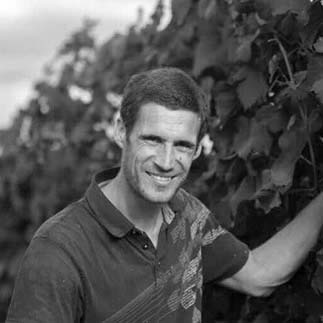
From blacksmith's grandson to biodynamic pioneer—Vincent Gross crafts soulful skin-contact wines in the medieval village of Gueberschwihr, where limestone meets Alsace's aromatic soul.
Four generations of family tradition—from Louis the blacksmith to Vincent the biodynamic visionary.
The Domaine Gross story begins in the late 1950s when Louis Gross, a blacksmith by trade, founded the farm with just 2 hectares of vines in Gueberschwihr, a charming medieval wine-growing village a few kilometers south of Colmar. This humble beginning laid the foundation for what would become one of Alsace's most exciting biodynamic estates [^95^].
In 1981, Louis's son Rémy Gross took over the estate, expanding the vineyard and establishing the family's reputation for quality. Then in 2006, Vincent joined his father, bringing with him a passion for biodynamic agriculture and a vision for natural winemaking that would transform the domaine [^81^][^95^].
It was during a tasting at a colleague in Bas-Rhin that Vincent discovered orange wines. In the process, he starts! First on a small quantity in 2016 but the wines intrigue and the demand becomes stronger.
Today, father and son farm 10 hectares together—"just enough to stay winemakers," as they say—and continue to warmly welcome customers to their cellar. The estate extends over the Grand Cru Goldert and many other terroirs, particularly limestone and clay, which lend themselves perfectly to Vincent's vision of expressive, skin-contact wines [^95^].
Biodynamic agriculture, Poussard pruning, and the art of skin-contact—wines with chew and salinity.
The Domaine Gross practices biodynamic agriculture throughout their 10 hectares. Care for the vines is done manually because the human hand allows delicacy in each gesture. They use plants (nettles, horsetails) to strengthen the action of sulfur and copper during treatments, and biodynamic preparations (MT compost, 500, 501) enhance the soil and improve vine development [^81^][^95^].
Vincent employs short pruning (taille Poussard) in winter to reduce the load per vine and obtain very aromatic wines. The harvest is done exclusively by hand with rigorous sorting in the vineyard. The whole grape is transported to the winery and loaded by gravity to preserve the integrity of the bunches [^81^].
Since 2016, Vincent has specialized in maceration wines—orange wines that see 3 weeks of skin contact. "With macerations, winemaking is more frank and serene. The wines are dry and express the terroir. They have chew and salinity… as well as an inimitable aromatic palette!" The wines are unfiltered, not sulfited, and made without any input [^95^].
- Taille Poussard (short pruning)
- Biodynamic preparations 500/501
- Nettle and horsetail teas
- Manual harvest with sorting
- Gravity-fed winery
- Indigenous yeasts only
Grand Cru Goldert, limestone cliffs, and clay-limestone soils—Alsace's geological diversity in every bottle.
Grand Cru Goldert
The estate's crown jewel—Goldert Grand Cru—where Vincent sources grapes for his most prestigious cuvées. This terroir of limestone and clay produces wines of exceptional depth and aging potential, particularly for the flagship Gold R skin-contact wine [^90^][^93^].
10 Hectares
Vincent and Rémy cultivate 10 hectares of biodynamic vineyards—"just enough to stay winemakers." The parcels range from deep limestone to clayey marl, bringing power and complexity to the wines. All work is manual, from pruning to harvest [^81^][^95^].
Gueberschwihr
A charming medieval village a few kilometers south of Colmar. The terroir here lends itself perfectly to skin-contact winemaking, with limestone and clay soils that bring power, salinity, and chew to Vincent's orange wines [^95^].
From coppery Gold R to Pirouettes Eros—skin-contact masterpieces and zero-sulfur expressions.
Gold R
A gorgeous coppery orange blend of Riesling, Gewurztraminer and Muscat with 28 days of skin maceration. Floral nose unfolding onto marmalade, candied lemon peel, orange blossom and heady incense. Concentrated like distilled oranges with structured, textured mouthfeel. An immersive experience from Grand Cru Goldert vines [^90^][^93^][^94^].
Gewurztraminer
Muscat
28 days maceration
TryO
Short for "Try Orange"—a trio of three varieties co-fermented for 3 weeks. Final SO2 of just 14mg/L. This is Vincent's gateway orange wine, offering the texture and complexity of skin contact with approachability. Fresh, expressive, and distinctly Alsatian [^90^].
3 weeks maceration
14mg/L SO2
Crémant d'Alsace
80% Auxerrois and 20% Riesling spending 24 months on lees. Final SO2 of just 7mg/L—remarkably low for traditional method sparkling. Delicate, refined, and showing the potential of biodynamic grapes in Crémant production [^90^].
20% Riesling
24 months lees
Eros de Vincent
Part of Christian Binner's Pirouettes collective—a project supporting biodynamic growers. 40% Gewurztraminer, 25% Riesling, 20% Sylvaner, 15% Pinot Gris from 18-year-old vines on limestone and sandstone. 14 days maceration, 8 months aging. "I loved making this skinsy Alsatian amber," says Vincent—tart, complex, and people-pleasing [^97^][^99^].
14 days maceration
Zero sulfites
Rhapsodie
A glowing ruby-pink wine with slight amber hints. Made from Pinot Gris with skin contact, this wine is incredibly expressive on the nose and palate. Shows the versatility of Alsace's noble grape when treated with natural winemaking techniques [^90^].
Ruby-pink color
Expressive nose
Goldert Riesling
Vincent's only white wine kept as white—made in a truly Grand Cru style in old foudres. From the prestigious Goldert terroir, this Riesling represents classical Alsace winemaking while maintaining the domaine's low-intervention philosophy [^90^].
Old foudres
Classical style
Neuweg
From the Neuweg lieu-dit—a specific terroir within the Gueberschwihr vineyards. This Gewurztraminer shows the spicy, aromatic character of the variety while maintaining the freshness and precision that biodynamic farming brings [^90^].
Gewurztraminer
Spicy & aromatic
Pinot Noir R
A light, fresh red from Pinot Noir grown on the estate. Fermented with indigenous yeasts and minimal intervention, this shows the potential for red wine in Alsace when handled with care. Light, fruity, and perfect for immediate enjoyment [^90^].
Light & fresh
Indigenous yeast
The Art of Maceration
Vincent Gross represents a new wave of Alsatian winemaking—one that respects tradition (four generations, Grand Cru terroir, biodynamic farming) while embracing innovation (skin-contact wines, zero sulfur, natural winemaking). His Gold R has become a benchmark for Alsace orange wine—coppery, complex, and deeply expressive of the Goldert Grand Cru [^93^].
Through his participation in Les Vins Pirouettes, Vincent collaborates with Christian Binner and other Alsatian natural winemakers to promote "soulful terroir wines made with zero nonsense." His work demonstrates that Alsace's aromatic varieties—Riesling, Gewurztraminer, Muscat—can transcend their traditional white wine boundaries to create textural, tannic, age-worthy orange wines that still express their terroir [^97^][^99^].
- Fourth generation (founded 1950s)
- Grandson of Louis Gross (blacksmith)
- Joined father Rémy in 2006
- Biodynamic since 2006
- 10 hectares (Goldert Grand Cru)
- Skin contact specialist (since 2016)
- Gold R (28-day maceration)
- Les Vins Pirouettes member
- Poussard pruning
- Nettle & horsetail teas
- Zero sulfur (macerations)
- Gueberschwihr limestone
- Manual harvest only